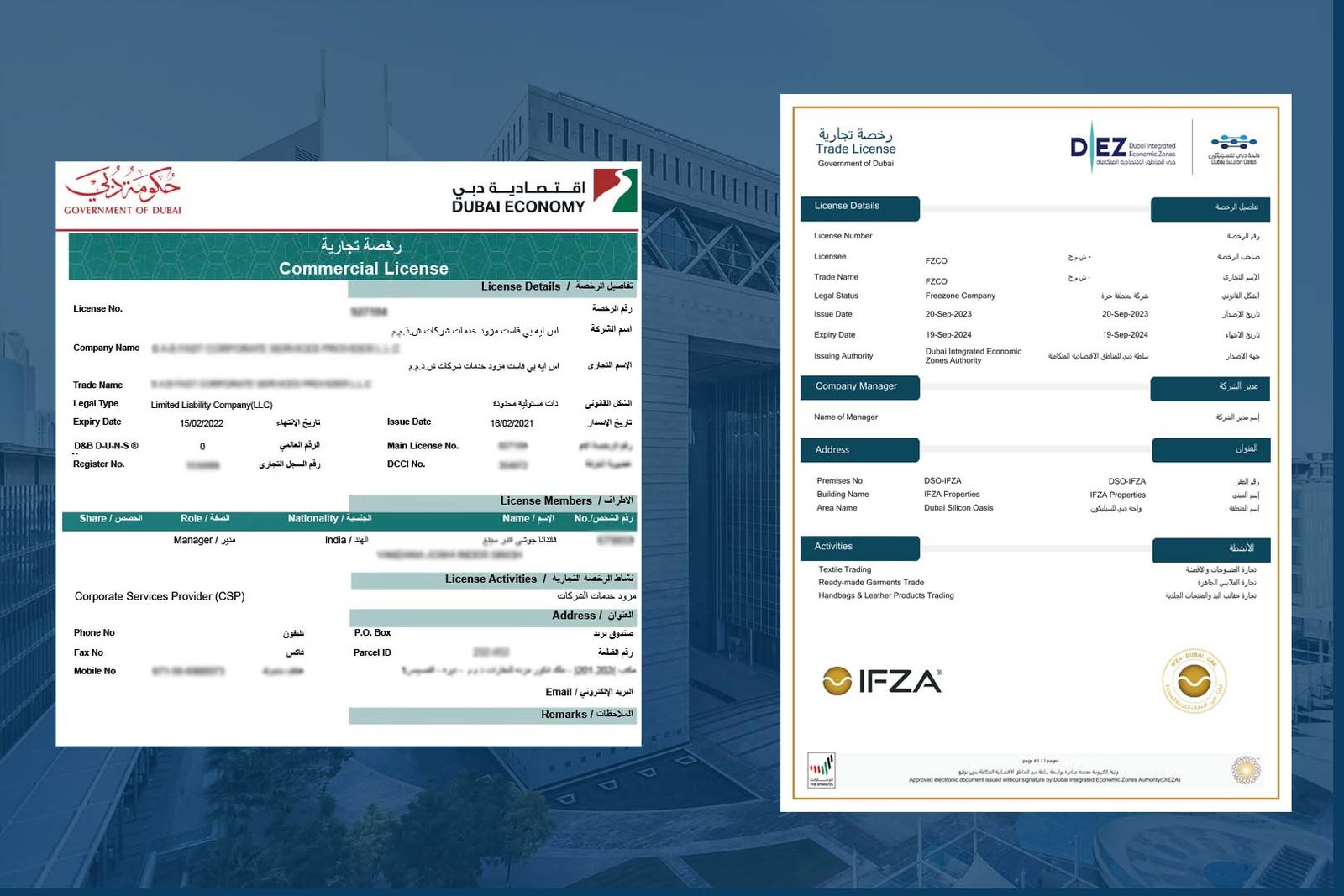

In the Setting up a business in Dubai This raises the question for many as to whether a Mainland Company (LLC) or a Freezone Company (FZCO) makes more sense. Below are the key differences, advantages and disadvantages of each legal form, as well as frequently asked questions.
In the first instance, this decision should be carefully considered to avoid unnecessary costs and to ensure lawful and efficient management.
What is a mainland company?
An onshore company is a Mainland company registered with the Department of Economic Development that can conduct business within and outside the UAE.
Trade licences for mainland companies are issued by the Department of Economic Development (DED), and their operations are subject to few, if any, restrictions, which is considered the main characteristic of mainland companies. However, some business activities require a local sponsor or a UAE national to partner with the company.
What is a Freezone company?
A free zone company is a company registered in a free zone, which is an autonomous judicial district within each emirate. The Free Zone Authority (FZA) is the regulatory body that operates free zones and governs their functions. There are currently over 45 free zones across the country, offering 100%iges ownership and many other unique features.
Overview of differences
Companies in free zones and on the mainland offer business owners a wide range of benefits and features. For example, companies in a free zone offer foreign investors the advantage of being 100% foreign-owned, being exempt from tax, and enjoying greater operational freedom within the free zone. Companies on the mainland, on the other hand, offer better access to the UAE and the global market, as well as the opportunity to conduct business throughout the country without restrictions.
Here are the main differences between the two companies:
- Ownership details In free zones, entrepreneurs own 100% of their businesses without needing a local sponsor. For companies on the mainland, foreign investors must have an Emirati partner who holds at least 51% of the company shares in order to carry out most business activities. This applies primarily to infrastructure and utilities such as hospitals, telecommunications and energy supply. However, most activities are now completely open to expats and, since 2021, no longer require a local sponsor.
- Location Companies in free zones are based in the designated free zones of the UAE, whereas mainland companies can be based anywhere in the country.
Workspace: Mainland companies must have an office space of at least 20 square metres to obtain a licence. However, companies in free zones are not required to provide a physical location, and many free zones allow companies to operate their businesses from virtual workplaces.
Scope of Business: Businesses in free zones are restricted in their dealings within the UAE market, as they are not allowed to trade directly with the UAE market, but only through locally appointed distributors. Businesses on the mainland, however, are exempt from this restriction and are allowed to conduct business anywhere in the UAE. - Authorisations Companies from the mainland require permits from various government bodies, including the Ministry of Economic Development, the municipalities, the Ministry of Labour, and others. Free zones have their own jurisdiction and their own regulations for starting a business, and you do not need a permit from government agencies outside the free zone to establish your company.
- Visa For mainland companies, there are no visa restrictions. However, the number of visas issued is dependent on the size of the company's workspace; the larger the workspace, the more visas can be granted.
While there are restrictions on the number of visas that can be applied for by companies in free zones, this depends on the regulations of the free zone and other conditions.
- Capital requirement The legal form of a company in the mainland determines its capital requirements, while requirements in a free zone are determined by the emirate in which the company is based.
Advantages of both legal forms
As an entrepreneur looking to set up a business in the UAE, you need to be fully aware of the benefits of both company structures to make the right decision. Below are the advantages of both types of companies.
Advantages of the Mainland
Here are the main points that are important for a Mainland Company Formation in DubaiI speak.
- No restrictions on doing business in the UAE.
- 100%ige repatriation of profits and capital in most business activities.
- No limit on the number of visas.
- Unrestricted access to local and global markets.
- More business activities compared to companies in a Freezone.
- Simple access to a business bank account.
Advantages of Free Zone
Below is an overview of the main advantages of a Freezone Company in Dubai.
- 100% foreign ownership without the need for a local sponsor.
- Simple and quick company formation.
- 100% Repatriation of capital and profits
- Lighter policy.
- Advanced infrastructure and employment opportunities.
- Low setup costs
FAQ
The most frequently asked questions for deciding between a Mainland and a Freezone company at a glance.
Can I switch easily if needed?
No, it is not possible to change the legal form of a company or to re-establish it. Therefore, one should be absolutely clear about which legal form is needed. If in doubt, prior consultation makes sense to avoid unnecessary costs.
Which legal form is cheaper?
Freezones are, at best, always cheaper than mainland companies. This is due to the licenses but also to the fact that they do not require a physical office.
I deal in property - do I need a mainland company?
For private investors, you don't fundamentally need a company at all. Even if you buy and sell dozens of properties every year. Nor is a company, neither Freezone nor Mainland, necessary for renting.
However, anyone who conducts trade and brokerage for others requires a mainland company.
I trade globally with a warehouse in Dubai - which legal form is better?
In principle, a free zone company is suitable for worldwide trade. Anyone needing storage space could opt for Jebel Ali Freezone (JAFZA), for example.
Summary
Whether to set up a Mainland or Freezone company depends very much on the company's purpose, i.e. its activity. Mainland LLCs offer many licences and allow the sale of physical products in the UAE. However, for those primarily operating internationally, a Freezone FZCO is usually better.
If you continue to be unsure which company structure is right for you, please feel free to contact us at any time and we will assist you in a no-obligation initial consultation.